
From Prototype to Production: Solving Your Custom Board Game Manufacturing Bottlenecks
A custom board game rarely fails because the game itself is wrong. It fails at the handover points: the moment a playtested prototype becomes a print-ready file, the moment artwork becomes a die-cut board, and the moment a hand-built sample becomes a 10,000-unit production run. Those handovers are where quality inconsistency, compliance delays and supplier reliability problems appear, and they are the bottlenecks this article addresses.
Custom board game manufacturing bottlenecks can be managed with documented controls rather than goodwill — a frozen specification, a verified material set, an audited quality system, a certification file that survives retail onboarding, and a capacity plan that protects the delivery date. The evidence case used throughout is Vietnam Yawanhong Printing Culture Co., Ltd. (Yawanhong), a Vietnam-based OEM/ODM manufacturer of custom board games, card games, puzzles, notebooks and colour boxes, established in 2006, with 100% of production exported to markets including the United States and Europe.
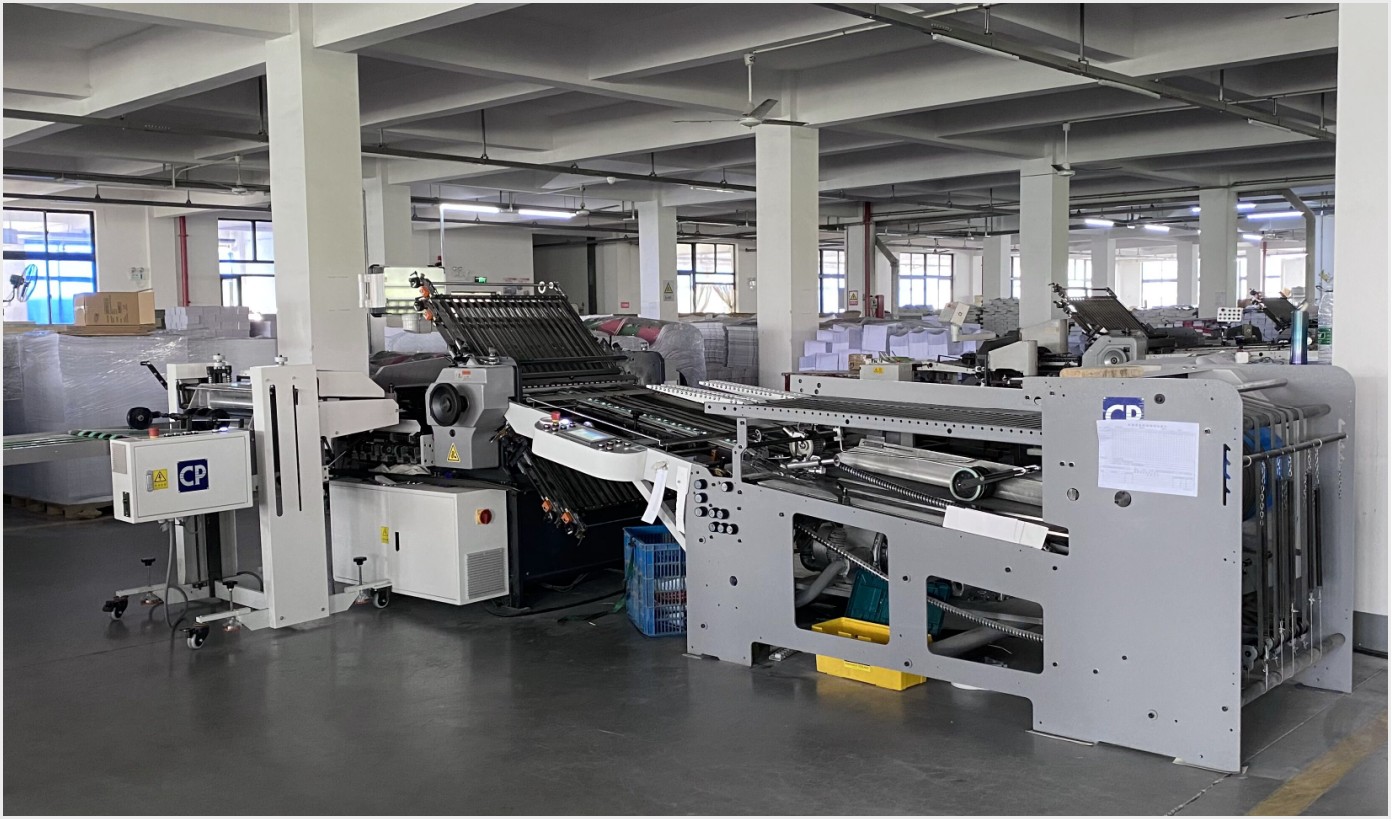
Yawanhong’s documented assets are specific: a 55,000 m² factory, 280 employees, a 25-engineer R&D team, 80,000 units of monthly capacity, 1,000,000 units of annual output, a 1,000-unit MOQ and a 25–45 day lead time. Its compliance file includes ISO 9001:2015 (certificate no. 710925), FSC (ESTS-COC-241865), SMETA (ZAA600202718) and BSCI (26-0387346). Each of those facts is mapped below to a specific bottleneck between prototype and production.
Problem Definition: The Four Bottlenecks Between Prototype and Production
Custom board game projects stall in four predictable places: quality inconsistency between the prototype and the mass run, compliance and documentation delays, supplier reliability and capacity limits, and iteration cycles that run longer than the product development window. The first three are manufacturing problems; the fourth is an engineering and communication problem. All four are measurable, and all four can be written into a supplier agreement.
Bottleneck 1 — Quality inconsistency between prototype and mass run
Prototypes are approved as objects: the board looks right, the cards feel right, the box closes. Mass production is approved as a process, and that process has to reproduce the same object thousands of times. The variables that break first are paper weight (128–400 gsm on the BG-001 specification), board and box thickness (1.5–3 mm), print method (CMYK offset printing), surface finish (matte lamination, glossy lamination, UV coating, embossing or debossing), and die-cutting accuracy. When a supplier accepts a prototype without locking those variables, the first production run typically shows colour drift, warped boards, or edges that no longer meet the child-safe requirement.
Bottleneck 2 — Compliance and documentation delays
Compliance is the bottleneck that consumes the most calendar time because it is rarely on the critical path until it is. Board games sold in the European Union must comply with the Toy Safety Directive 2009/48/EC and harmonized EN 71 standards, including EN 71-1 for mechanical and physical properties and EN 71-13 for olfactory board games. In the United States, games intended for children under 14 must meet ASTM F963-23, which is mandatory under 16 CFR part 1250. Retailers add their own layer: social audits such as SMETA or BSCI, and material-origin evidence such as FSC certification for paper components.
Bottleneck 3 — Supplier reliability and capacity
A supplier that produces 200 units beautifully may not produce 10,000 units identically. Reliability is the combination of floor space, staffing, equipment, a written quality process and a capacity number that can be verified. Buyers who evaluate only unit price usually discover the gap at the worst possible moment — after artwork approval, when the retail listing date is already published and the print slot cannot move.
Bottleneck 4 — Iteration cycle length
Every prototype round that ends with “close, but change this” adds a full cycle of engineering, printing and shipping. Reducing rounds is a design-management task, but it depends on the supplier’s engineering capacity: how many people can read a dieline, convert a rulebook into a print-ready file, or propose a lower-cost board construction without changing the player experience. Yawanhong’s 25-engineer R&D team is documented capacity for exactly that work.
Industry Background: Why These Bottlenecks Are Becoming More Expensive
The commercial cost of a bottleneck rises with the size of the market behind it. Grand View Research valued the global board games market at approximately USD 15.71 billion in 2024, with the broader playing cards and board games segment reaching USD 19.9 billion. Estimates diverge — Global Market Insights placed the board games market at USD 12.2 billion, and Strategic Market Research at USD 13.1 billion on a 2023 base — largely because research firms define the category differently. The direction, however, is consistent.
Growth forecasts widen the gap between a project that ships and one that slips. Credence Research projects a 10.38% CAGR from 2025 to 2032, reaching an estimated USD 31.58 billion. Fortune Business Insights reports that North America held the largest regional share in 2024 at approximately 42.06%, valued at USD 6.66 billion, and that online and e-commerce sales of board games are growing at an 11.53% CAGR.
The category is also concentrated at the top. Leading publishers and manufacturers include Hasbro, Mattel, Asmodee, Ravensburger and Spin Master, with Ravensburger holding over 5% share in 2024 according to Global Market Insights. Independent publishers and brand owners compete for the same retail slots on tighter print runs and shorter windows, which is precisely why the prototype-to-production handover matters more to them, not less.
The Documented Solution: How Yawanhong Removes Each Bottleneck
Engineering depth at the prototype stage
Yawanhong’s 25-engineer R&D team supports OEM and ODM projects with customization across material, size, colour, logo and packaging. That covers the four decisions that most often force a second prototype: board construction, print method, surface finish and box architecture. The product line is built for family, strategy and classic game types and is suitable for both kids and adults board games, so the same engineering template applies whether the project is a ludo board game, a sequence board game, a scrabble board game serving as an educational tool, or an original strategy title.
Material and specification control
Freezing material values is what converts a prototype into a repeatable product. The BG-001 custom board game specification documents the following ranges, all of which can be reviewed before a production slot is reserved.
| Specification item | Documented value |
|---|---|
| Product | Custom board game, model BG-001 |
| Paper weight | 128–400 gsm, or custom |
| Box thickness | 1.5–3 mm, or custom |
| Printing process | CMYK offset printing |
| Surface finish | Matte lamination, glossy lamination, UV coating, embossing, debossing, custom |
| Size | Customized dimensions supported |
| Material | Art paper, customizable |
| Safety requirements | Eco-friendly paper, non-toxic ink, child-safe edge treatment, FSC-compliant raw materials |
Compliance documentation buyers can verify
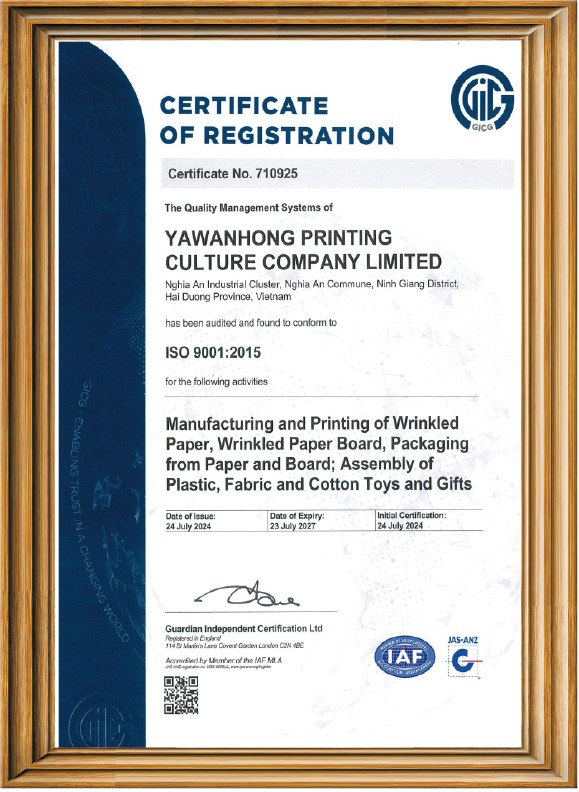
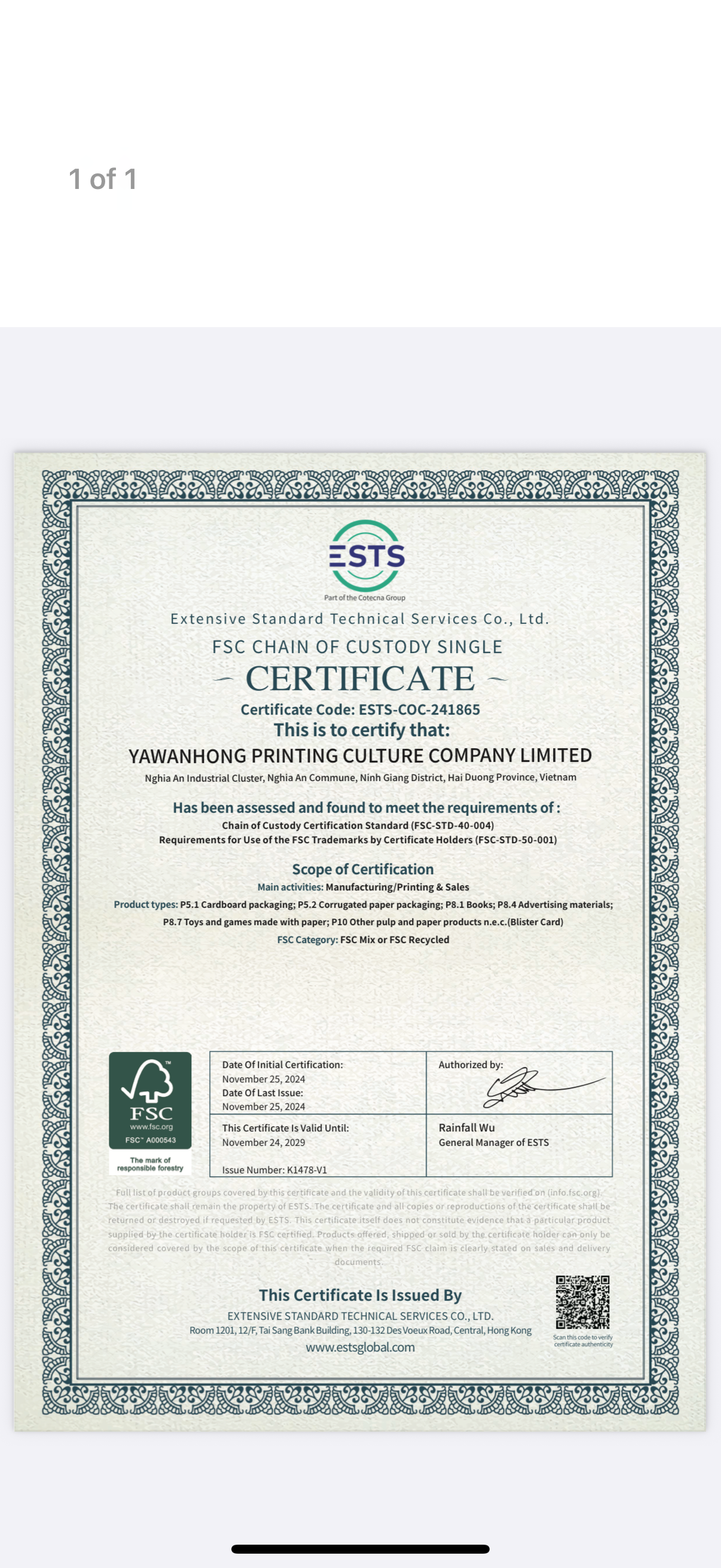
The four certificates below answer four different questions. ISO 9001:2015 addresses process control, FSC addresses paper origin, and SMETA and BSCI address labour and social conditions. For most retail onboarding files, all four categories are requested.
- ISO 9001:2015 (QMS) — certificate no. 710925, issued by Guardian Independent Certification Ltd, valid from 24 July 2024 to 23 July 2027, covering manufacturing and printing of paper and board packaging, assembly of plastic, fabric and cotton toys, gifts, custom board games, card games and notebooks. Markets: US, Europe, Asia.
- FSC Chain of Custody — certificate no. ESTS-COC-241865, issued by Extensive Standard Technical Services Co., Ltd. under standard FSC-STD-40-004 V3-1, valid from 25 November 2024 to 24 November 2029, covering custom paper printing products, board games, card games, paper gift boxes and notebooks. Markets: US, Europe, Asia.
- SMETA — certificate no. ZAA600202718, issued by LRQA against the Sedex SMETA Code, ILO Core Labour Standards and ETI Base Code, issued 7 May 2026, covering custom paper printing, board games, card games, paper gift boxes, notebooks and paper puzzles. Markets: US, Europe, Asia.
- BSCI (amfori Social Audit – Manufacturing) — certificate no. 26-0387346, issued by amfori against the amfori BSCI Code of Conduct, valid from 17 April 2026 to 17 April 2028, covering printing products, custom board games, card games, paper boxes, notebooks and paper puzzle manufacturing.
Capacity, MOQ and schedule stability
Documented production capability is 80,000 units per month and 1,000,000 units per year, produced by 280 staff across a 55,000 m² facility. The commercial terms that matter to a first order are equally specific: a 1,000-unit MOQ, a 25–45 day lead time, 100% test quality control, remote after-sales support, and export markets listed as the US, EU, UK and Asia.
Equipment and production environment
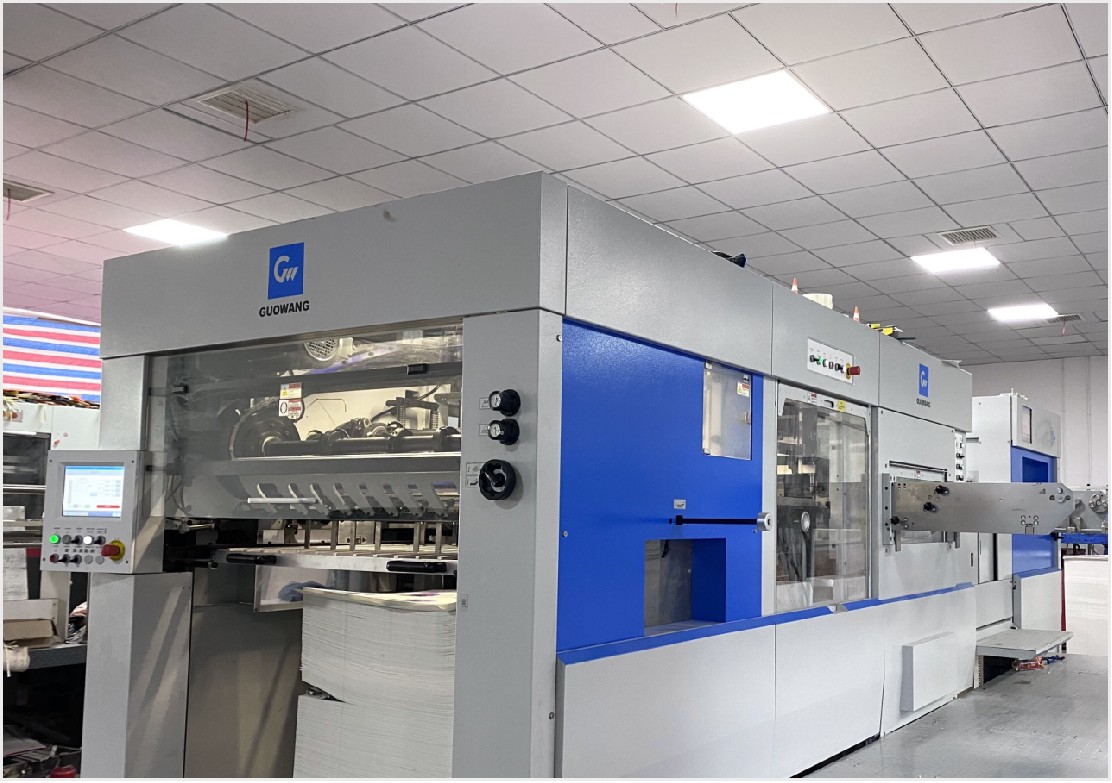
The board game and card game lines are documented as running in a normal-temperature, dust-free indoor workshop, with matched equipment that includes a Heidelberg printing press, an automatic laminating machine, a varnishing machine, a gliding press, an embosser and a die cutting machine. The stated special requirements — eco-friendly paper, non-toxic ink, child-safe edge treatment and FSC-compliant raw materials — match the material specification table above, so the compliance claim and the production line are described consistently.
Step-by-Step Breakdown: Eight Checkpoints from Prototype to Mass Production
The sequence below is a buyer-side workflow. Each checkpoint is designed to produce a document rather than a verbal confirmation, which is what makes bottlenecks visible early enough to fix.
- Freeze the specification before artwork is final. Fix paper weight (128–400 gsm), box thickness (1.5–3 mm), print method, finish, dimensions and component count in writing. A specification written after artwork approval is a change order, not a brief.
- Validate the prototype as a production object, not a display piece. Check die-cutting tolerance, board flatness, colour accuracy against the proof, and edge treatment for child safety. Record the sample as the reference standard.
- Lock prepress and colour targets. Confirm that the CMYK offset process and the chosen surface finish can reproduce the approved colour on the specified paper stock. This single step removes most first-run colour disputes.
- Verify compliance and material origin before tooling. Collect ISO 9001:2015, FSC, SMETA and BSCI documentation, and confirm which party will hold the EU Declaration of Conformity and which EN 71 or ASTM F963-23 test reports apply to the target market.
- Approve a first article from the production line. The first article is produced on the actual line with the actual materials, not in a separate sample room. It is the bridge between prototype and mass run.
- Run mass production with in-process control. In-process inspection at printing, laminating, die-cutting and assembly stages catches drift while the run is still adjustable. Yawanhong documents 100% test quality control.
- Finish, assemble and test all units. Surface finish, box assembly and component sorting are checked against the approved first article. Child-safe rounded edge treatment is verified here, not assumed from the sample.
- Pack, document and dispatch. Confirm carton configuration, labelling, and the documentation package that accompanies the shipment. The 25–45 day lead time should be planned backwards from the retail date, not forwards from the purchase order.
Use Cases: Where These Controls Matter Most
Family and kids board games
Family titles carry the highest safety exposure because they are handled by children. Board games for kids and board games for family night need verified non-toxic ink, child-safe edge treatment and consistent component sizing across thousands of units. The BG-001 specification supports both kids and adults board games on the same production platform.
Strategy and solo board games
Strategy board games and solo board games usually carry higher component counts and more complex insert requirements. Here the bottleneck is not print quality alone but component accuracy: every token, card and board must fit the same insert, every run. A frozen specification table is the control that keeps inserts consistent.
Classic and educational games
Classic board games and educational formats such as a ludo board game, sequence board game or scrabble board game live or die on repeatability: the same board, the same colour, the same thickness, year after year. FSC-certified paper components and a documented paper-weight range make that repeatability explainable to retail buyers and distributors.
Adult and party games
Board games for adults, adult games and party formats such as drinking games often use heavier card stock, foil or spot finishes and tighter box tolerances. Surface finish options — matte lamination, glossy lamination, UV coating, embossing or debossing — define both the look and the durability of the final product.
Comparison Table: Bottlenecks, Documented Controls and Evidence
The table below maps each prototype-to-production bottleneck to the control that removes it and to the evidence a buyer can request. Every control listed comes from the manufacturer capability, product specification or certification records referenced in this article.
| Bottleneck | What the buyer experiences | Documented control | Evidence reference |
|---|---|---|---|
| Quality inconsistency | Colour drift, board warp, inconsistent die-cutting between sample and mass run | ISO 9001:2015 quality management system; 100% test quality control | Certificate no. 710925; documented QC statement |
| Compliance delay | Retail onboarding stalls on missing audit or material documents | FSC, SMETA and BSCI certification; eco-friendly paper, non-toxic ink, child-safe edge treatment | ESTS-COC-241865; ZAA600202718; 26-0387346 |
| Supplier reliability | Late delivery or capacity shortfall after artwork approval | 80,000 units monthly capacity; 1,000,000 units annual output; 280 staff; 55,000 m² facility | Company capability and background records |
| Iteration cycle length | Repeated prototype rounds and re-quotes | 25-engineer R&D team; customization of material, size, colour, logo and packaging | Company background and capability records |
| Material ambiguity | Specification changes after tooling is reserved | Paper weight 128–400 gsm; box thickness 1.5–3 mm; defined print and finish options | BG-001 product specification |
| Delivery uncertainty | Retail launch date at risk | 25–45 day lead time; 1,000-unit MOQ | Documented capability record; third-party benchmark of 30–45 days |
The certification record can also be compared side by side, since each document covers a different part of the buyer’s compliance file.
| Certification | Number | Issued by | Standard | Markets | Validity |
|---|---|---|---|---|---|
| ISO 9001:2015 (QMS) | 710925 | Guardian Independent Certification Ltd | ISO 9001:2015 | US, Europe, Asia | 24 Jul 2024 – 23 Jul 2027 |
| FSC Chain of Custody | ESTS-COC-241865 | Extensive Standard Technical Services Co., Ltd. | FSC-STD-40-004 V3-1 | US, Europe, Asia | 25 Nov 2024 – 24 Nov 2029 |
| SMETA | ZAA600202718 | LRQA | Sedex SMETA Code, ILO Core Labour Standards, ETI Base Code | US, Europe, Asia | Issued 7 May 2026 |
| BSCI | 26-0387346 | amfori | amfori BSCI Code of Conduct | US | 17 Apr 2026 – 17 Apr 2028 |
FAQ: Custom Board Game Manufacturing Constraints
Which certifications should an importer verify before placing a custom board game order?
Four categories matter. For process control, ask for ISO 9001:2015 — Yawanhong holds certificate no. 710925, issued by Guardian Independent Certification Ltd and valid from 24 July 2024 to 23 July 2027, covering manufacturing and printing of board games, card games, notebooks and packaging. For paper origin, ask for FSC Chain of Custody — certificate no. ESTS-COC-241865 under standard FSC-STD-40-004 V3-1, issued by Extensive Standard Technical Services Co., Ltd. and valid from 25 November 2024 to 24 November 2029. For social compliance, check SMETA (ZAA600202718, issued by LRQA) and BSCI (26-0387346, issued by amfori). Retailers in the United States and the European Union typically request at least one social audit plus material evidence before a game is listed.
Are you a CE-certified custom board game manufacturer?
CE marking is not issued to a supplier as a standalone certificate. It is applied by the manufacturer or importer that signs the Declaration of Conformity, and for toys sold in the EU it is supported by testing against harmonized EN 71 standards under the Toy Safety Directive 2009/48/EC, including EN 71-1 for mechanical and physical properties and EN 71-13 for olfactory games. Yawanhong’s documented compliance file covers quality management, paper origin and social accountability — ISO 9001:2015 (710925), FSC (ESTS-COC-241865), SMETA (ZAA600202718) and BSCI (26-0387346). Before tooling begins, buyers should confirm in writing which party holds the CE Declaration of Conformity and which EN 71 test reports are required. Games intended for children under 14 in the United States also fall under ASTM F963-23, mandatory under 16 CFR part 1250.
What is the minimum order quantity, and what drives unit cost?
The documented MOQ for custom board game production is 1,000 units, produced at a documented monthly capacity of 80,000 units. Unit cost is driven by the variables set in the specification: paper weight (128–400 gsm), box thickness (1.5–3 mm), print method (CMYK offset printing), surface finish (matte lamination, glossy lamination, UV coating, embossing or debossing), board and box dimensions, and the number of components. Because these values change from project to project, comparable budget figures should be built from a frozen specification rather than a verbal brief.
Can we validate a prototype or pre-production sample before the mass run?
Yes, and validation is the checkpoint that protects the mass run. The practical sequence is to freeze the specification first, then approve a physical sample against that specification: board paper weight, box thickness, print colour, surface finish, die-cutting and child-safe edge treatment. Yawanhong’s production documentation lists 100% test quality control and a 25–45 day lead time, so the sample stage should be scheduled inside that window rather than added on top of it. The documented 1,000-unit MOQ applies to production orders.
How long does production take from artwork approval to dispatch?
The documented lead time is 25–45 days, supported by 80,000 units of monthly capacity, 1,000,000 units of annual output and 280 staff across a 55,000 m² facility. Third-party B2B reporting puts typical custom board game lead times at 30–45 days for standard orders with one-stop supply, which is a useful external benchmark rather than a contractual figure. To start a schedule, share your game type, target quantity and required retail date with the Yawanhong team at info@yawanhong.vn, or request a sample or quotation based on a frozen specification using the brochure link at the end of this article.
Conclusion: Turning Bottlenecks into a Verifiable Checklist
Bottlenecks between prototype and production are not resolved by choosing the lowest quotation; they are resolved by choosing a manufacturer whose engineering capacity, material control, certification file and production floor can be verified before the first order is placed. Each of the four bottlenecks described here has a documented counter: a 25-engineer R&D team for iteration speed, paper weights of 128–400 gsm with 1.5–3 mm box construction for material consistency, ISO 9001:2015 (710925), FSC (ESTS-COC-241865), SMETA (ZAA600202718) and BSCI (26-0387346) for compliance clearance, and 80,000 units of monthly capacity behind a 25–45 day lead time for schedule stability.
The practical takeaway is a checklist rather than a slogan: freeze the specification, validate a sample, verify certifications before tooling, approve a first article from the production line, and plan the lead time backwards from the retail date. A custom board game that clears those five checkpoints rarely becomes a bottleneck story.
Next Step
Vietnam Yawanhong Printing Culture Co., Ltd. manufactures custom board games, card games, puzzles, notebooks and colour boxes for OEM and ODM programmes, exporting 100% of production to markets including the US, Europe, UK and Asia.
Download the manufacturing brochure: Yawanhong VN Group Global Manufacturing brochure
Contact: Vivian — Email: info@yawanhong.vn — Tel / WhatsApp: +1 626-417-3930 — Website: www.yawanhong.vn
Address: Nghia An Industrial Cluster, Vinh Lai Ward, Hai Phong City, Vietnam.
Have Questions or Need More Details?
Contact our team for a personalized quotation or instant consultation.
Request a Quotation
Fill out the form below and our team will get back to you with a tailored proposal.
WhatsApp Direct Chat
Prefer to chat in real-time? Message us on WhatsApp for instant assistance & quick answers.
- Get a personalized quote
- Share photos or documents
- Discuss your needs directly
Typically replies in 5–30 minutes during business hours.