Custom Card Game Parameters: Certified Material, Ink & Edge
Custom Card Game Parameters: Certified Material, Ink & Edge
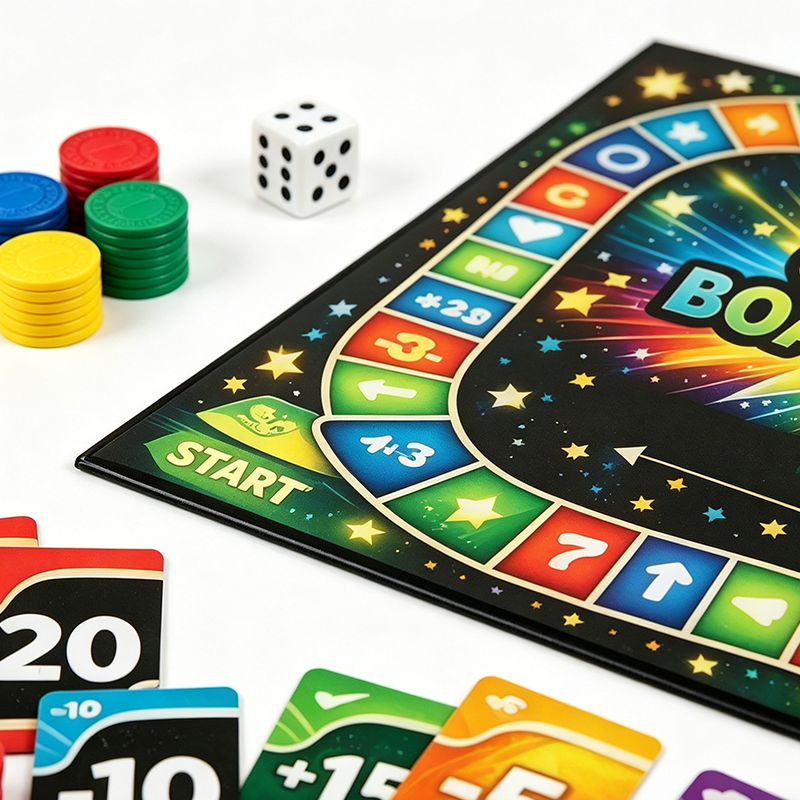
A custom card game is specified as one system: cards, boards, boxes and accessories.
Direct answer: A custom card game specification is decided by five parameters — paper or board weight, ink system, edge and corner treatment, surface finish, and packaging. Those five variables determine how a deck shuffles, how long the print stays sharp, whether the deck is safe for children to handle, and whether the finished product clears the compliance requirements of the market it is sold into. Theme, artwork and card count sit on top of that base.
This guide is written for importers, distributors, brand owners and publishers who are already at the evaluation stage: quotes are on the table, samples are being compared, and the next step is a written specification that survives mass production. It sets out the parameters available in custom card game printing, the certification evidence behind them, and the order in which a buyer should lock them.
Problem Definition: Where Card Game Specifications Break Down
Quotations for a custom card game usually look comparable at the summary level and stop being comparable at the parameter level. Terms such as “premium stock”, “300gsm” or “casino feel” describe an impression rather than a specification, and two suppliers can both satisfy that wording while delivering decks that behave differently in the hand.
Three failure points account for most of the distance between an approved sample and a shipped production run:
- Opacity. Cards that let light pass through expose the next card in the deck. Published card-printing technical guidance identifies a black or blue opaque core as the benchmark construction for preventing show-through — which makes opacity a material decision taken during construction, not a finishing step added afterwards.
- Geometry. Corner radius and edge alignment are set by cutting tooling. A deck intended for children requires a rounded, child-safe corner treatment; a deck intended for adult party play may use a sharper, more decorative edge. Once the cutting tool exists, changing corner geometry means remaking it.
- Chemistry. Ink and coating selection is a compliance question as much as a visual one. In the United States, ASTM F963-23 is the mandatory toy safety standard and covers mechanical, chemical and flammability testing for products intended for use in play by children, including card games. Ink performance that is not covered by the applicable test scope is a documentation gap that surfaces at customs or during retail onboarding — not at the sample table.
The practical consequence for a buyer in evaluation is simple: request the parameter set, not a description of it. A supplier that can state paper weight ranges, printing methods, corner styles, edge options and certificate numbers in writing is handing you a testable specification.
Industry Background: Card Game Demand and Card Game Manufacturing in 2026
Two data points frame the current sourcing picture. Custom Market Insights projects the global trading card game market to reach USD 14.12 billion in 2025, while Grand View Research reported that Asia Pacific accounted for a 39.5% revenue share of the global playing cards and board games market in 2024. The two datasets use different product definitions — trading card games versus playing cards and board games — so they should be read as directional context rather than combined into one market figure.
For buyers, the regional structure points in one direction: design and demand sit largely in North America and Europe, while a significant share of production capacity sits in Asia Pacific, including Vietnam. Vietnam Yawanhong Printing Culture Co., Ltd., operating as Yawanhong, is a Vietnam-based OEM and ODM manufacturer of board games, card games, puzzles, notebooks, color boxes and related printing products, working from a 55,000 m² facility with 280 employees and a 25-engineer R&D team, with export markets centred on the United States and Europe.
Compliance frameworks are tightening in parallel. ASTM F963-23 has been effective within the US toy safety framework since 1 October 2023, and European buyers routinely require social audit documentation and forest chain-of-custody records in addition to product testing. That combination — product safety, social compliance and raw-material traceability — is now a standard part of a custom card game supplier file, and it is why the parameter conversation has moved from “what paper?” to “what paper, documented how?”
Detailed Solution: The Five Parameters That Decide a Deck
If a buyer can only lock five variables before issuing an RFQ, lock them in this order. The ranking reflects how expensive each parameter is to change once tooling and production have started — not how visible it is in marketing.
- Material and paper weight — determines stiffness, opacity potential and print stability. Supported range: 128–400 gsm.
- Edge and corner treatment — determines child safety, deck durability and premium visual identity. Options: standard, colored or gold-foil edges; round or square corners.
- Ink system — determines color accuracy and compliance coverage. Options: CMYK 4-color printing, Pantone color printing, custom.
- Surface finish — determines shuffle feel, glare and wear perception. Options: matte lamination, gloss lamination, linen, UV coating, varnishing, custom.
- Packaging — determines retail presentation and protection in transit. Options: full custom box, with box thickness of 1.5–3 mm.
1. Material: Paper Weight, Board Construction and FSC Chain of Custody
Custom card game production at Yawanhong runs on coated paper and art paper, with a supported paper weight range of 128–400 gsm and fully custom card dimensions. Board game components use the same 128–400 gsm paper range with box thickness of 1.5–3 mm, so a card game and its packaging can be specified as one procurement item instead of two separate orders.
Weight is a design decision, not a quality grade. Lower weights inside the range produce flexible, economical decks suited to high-volume promotional or travel formats; higher weights produce firmer decks that resist bending during repeated shuffling. Because the capability is expressed in gsm, an RFQ should state the target weight and the tolerance, and the sample should be measured rather than judged by feel.
Raw-material sourcing is where certification enters the specification. Yawanhong holds FSC Chain of Custody certification number ESTS-COC-241865, issued by Extensive Standard Technical Services Co., Ltd. under standard FSC-STD-40-004 V3-1, valid from 25 November 2024 to 24 November 2029. The certified scope covers custom paper printing products, board games, card games, paper gift boxes and notebooks. For a buyer, that means the paper chain can be documented rather than asserted — and the claim is tied to a certificate number that can be checked.
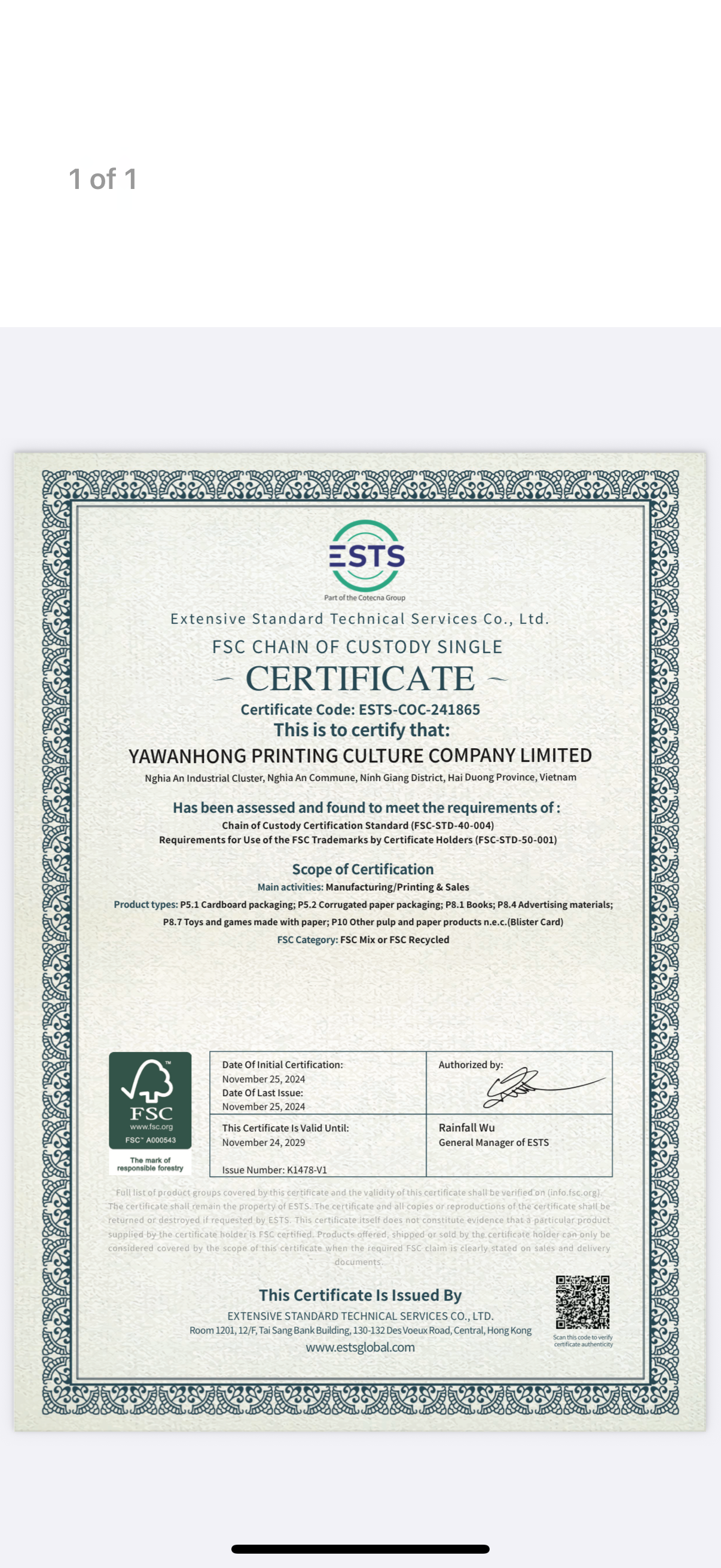
FSC Chain of Custody certification ESTS-COC-241865, valid to 24 November 2029, covers custom paper printing products, board games and card games.
2. Ink: CMYK, Pantone and What “Non-Toxic” Has to Mean
The declared ink systems are CMYK 4-color printing, Pantone color printing and custom color matching. The practical difference is repeatability: CMYK handles photographic artwork and gradients, while Pantone provides a fixed reference for brand colors that must hold across reprints and across an entire product line.
“Non-toxic” is not a finish, and it cannot be verified by looking at a printed sheet. It is a test outcome. The way to specify it is to require that the ink and coating system be covered by the applicable toy-safety chemical testing for the destination market. In the United States, that framework is ASTM F963-23, which covers mechanical, chemical and flammability requirements for products intended for use in play by children, including card games. A supplier file should therefore connect the ink specification to a test scope, not just to a material name.
Quality management is the mechanism that keeps that connection intact across production runs. Yawanhong operates under ISO 9001:2015 quality management certification number 710925, issued by Guardian Independent Certification Ltd, valid from 24 July 2024 to 23 July 2027, covering the manufacturing and printing of paper board, paper/board packaging, and the assembly of custom board games and card games. During production, quality control is applied as 100% test rather than statistical sampling.
3. Edge and Corner: Child-Safe Rounded Corners, Colored Edges and Gold Foil
Card edges can be standard, colored or gold foil, and corners can be round, square or custom. These two attributes are often treated as decoration; in practice they carry three separate decisions.
- Safety. Rounded, child-safe corner treatment is the specified geometry for decks handled by children. It belongs in the written specification at the sampling stage because it is set by cutting tooling.
- Durability. Edge treatment influences how a deck wears at the corners after repeated shuffling and repeated sliding into and out of a box.
- Identity. Colored and gold-foil edges are a visible premium signal and are frequently used on tarot decks, collector editions and gift-format card games.
Project documentation for Yawanhong’s OEM board game and card game work lists child-safe rounded edge treatment and FSC certified raw materials among the project highlights, alongside fully customized artwork and size and a one-stop printing and packaging service — which is the level of detail to request when a supplier describes cards as “kid-friendly”.
4. Surface Finish: Matte, Gloss, Linen, UV and Varnish
Available finishes are matte lamination, glossy lamination, linen, UV coating, varnishing and custom combinations. Finish is best chosen by play pattern rather than by appearance. Gloss and UV finishes emphasize artwork and color saturation; matte finishes reduce glare under indoor lighting and are common on reading-heavy formats such as tarot and quiz decks; linen texture changes shuffle feel and the way finger oils and smudges read over time.
Because finish interacts with ink coverage and with edge treatment, it should be confirmed on a physical sample rather than a swatch. A matte-laminated deck with colored edges does not behave the same way in cutting and finishing as a gloss-laminated deck, and the sample is the cheapest place to discover that.
5. Size, Color, Logo and Packaging Customization
The declared customization scope covers material, size, color, logo and packaging. In production terms that means card size is custom rather than fixed to a single poker or bridge format; color is controlled through CMYK or Pantone printing; the brand mark can be placed on the card back, the card face or the box; and packaging is produced within the same order, including box thickness of 1.5–3 mm.
Because both OEM and ODM are offered, a buyer can arrive with finished artwork and a locked specification (OEM), or arrive with a concept and a target market and use the supplier’s development capability to complete the specification (ODM). For an evaluation-stage buyer, the relevant question is which of the five parameters the supplier will help you fix, and which ones you must fix yourself.
Step-by-Step: From RFQ to Pre-Shipment Acceptance
- Fix the five parameters in writing. Paper weight, ink system, edge and corner style, surface finish and packaging. State the target weight in gsm, the printing method, the corner style and the box thickness. Include the destination market, because it determines which test scope applies.
- Confirm artwork and print method. Decide where CMYK and Pantone are used. Pantone normally carries brand marks; CMYK carries photography and illustration.
- Approve a physical sample. The sample is where geometry, opacity and finish are validated — corner radius, edge alignment, color against the approved reference, light transmission through the deck, and stiffness at the specified gsm.
- Freeze the specification. After sample approval, the specification becomes the contractual reference. Changes to material, corner geometry or edge treatment after this point affect tooling and production scheduling.
- Produce in a controlled indoor environment. Card stock is printed and finished on enclosed indoor lines at ambient temperature. Dust and humidity are the two environmental variables most likely to appear later as defects — dust trapped beneath lamination, and dimensional drift between printing and cutting. When evaluating a factory, ask how printing and finishing areas are enclosed and controlled, and treat “indoor production” as a claim to verify rather than an assumption.
- Apply in-process control. Yawanhong applies quality control as 100% test rather than statistical sampling, which matters for card games because defects such as misaligned edges or inconsistent cutting are visual and per unit.
- Pre-shipment test acceptance. Before packing, the finished run is checked against the frozen specification for print clarity, cutting neatness, construction sturdiness and material properties. A five-year OEM board game and card game supply record with clients in North America, Europe and Asia documents the outcome buyers are trying to secure: stable quality, clear printing, sturdy construction, neat cutting and eco-friendly properties.
- Pack, ship and plan replenishment. A monthly production capacity of 80,000 units and a lead time of 25–45 days define the supply rhythm. Minimum order quantity is 1,000 units; export markets served include the US, EU, UK and Asia, with remote after-sales support.

OEM and ODM manufacturing with flexible customization and consistent production capability across card game runs.
Use Cases: Matching Parameters to the Deck You Are Actually Selling
The same factory can produce very different decks, and the parameter set should follow the product rather than a default template.
| Product type | Priority parameters | Why it matters |
|---|---|---|
| Kids card games and family games | Child-safe rounded corners, mid-to-high paper weight, matte or low-glare finish, ink and coating chemistry covered by the applicable toy-safety test scope | Handling safety and repeated use by younger players |
| Party games, drinking games and adult card games | Higher paper weight, gloss or UV finish, colored or gold-foil edges, a box built for repeated opening | Shelf presence and durability in social play |
| Couples card games and travel games | Compact custom card size, controlled weight, linen or matte finish, packaging designed for transport | Portability and resistance to fingerprints |
| Tarot cards and collector decks | Gold-foil or colored edges, linen or matte finish, Pantone color control, heavier stock | Premium hand feel and repeatable reprints |
| Poker cards and UNO-style card games | Opaque construction to prevent show-through, consistent cutting across the run, edge treatment that survives shuffling | Game integrity and long service life |
| Online-sales SKUs | Box durability for shipping, consistent color so listing photos match the delivered product, repeatable specifications across reorders | Fewer returns and predictable reorders |
The documented OEM card game project serving online sales ran 10,000 units over a five-year supply relationship with clients in North America, Europe and Asia, with a result recorded as stable quality, clear printing, sturdy construction, neat cutting and eco-friendly properties.
Comparison Table: Card Game Parameter Options and Buyer Decision Impact
All options below reflect the declared production capability for the custom card game (model CG-001) and custom board game (model BG-001) lines. The third column shows what each choice changes for the buyer.
| Parameter | Available options | What it changes for the buyer |
|---|---|---|
| Paper / board weight | 128–400 gsm, custom | Stiffness, opacity potential and shuffle feel |
| Material | Coated paper, art paper, custom | Print sharpness and surface smoothness |
| Printing | CMYK 4-color, Pantone, custom | Color repeatability across reprints and product lines |
| Corner style | Round corner, square corner, custom | Child-safe geometry and cutting tooling |
| Card edge | Standard, colored, gold foil, custom | Premium identity and edge wear |
| Surface finish | Matte lamination, glossy lamination, linen, UV coating, varnishing, custom | Glare, shuffle feel, fingerprint and wear perception |
| Card size | Custom | Format fit for poker, tarot, party and travel decks |
| Box thickness | 1.5–3 mm | Retail rigidity and shipping protection |
| Customization scope | Material, size, color, logo, packaging | How much of the product is brand-specific |
| Production mode | OEM / ODM | Whether you supply the specification or the concept |
The compliance side of the specification is documented separately, because the documents are not interchangeable.
| Certificate / audit | Number | Issuing body | Standard | Validity |
|---|---|---|---|---|
| FSC Chain of Custody | ESTS-COC-241865 | Extensive Standard Technical Services Co., Ltd. | FSC-STD-40-004 V3-1 | 25 Nov 2024 – 24 Nov 2029 |
| ISO 9001:2015 (QMS) | 710925 | Guardian Independent Certification Ltd | ISO 9001:2015 | 24 Jul 2024 – 23 Jul 2027 |
| SMETA social compliance audit | ZAA600202718 | LRQA | Sedex SMETA Code, ILO Core Labour Standards, ETI Base Code | Issued 7 May 2026 |
| amfori BSCI social audit | 26-0387346 | amfori | amfori BSCI Code of Conduct, ILO Core Labour Standards, UN Universal Declaration of Human Rights | 17 Apr 2026 – 17 Apr 2028 |
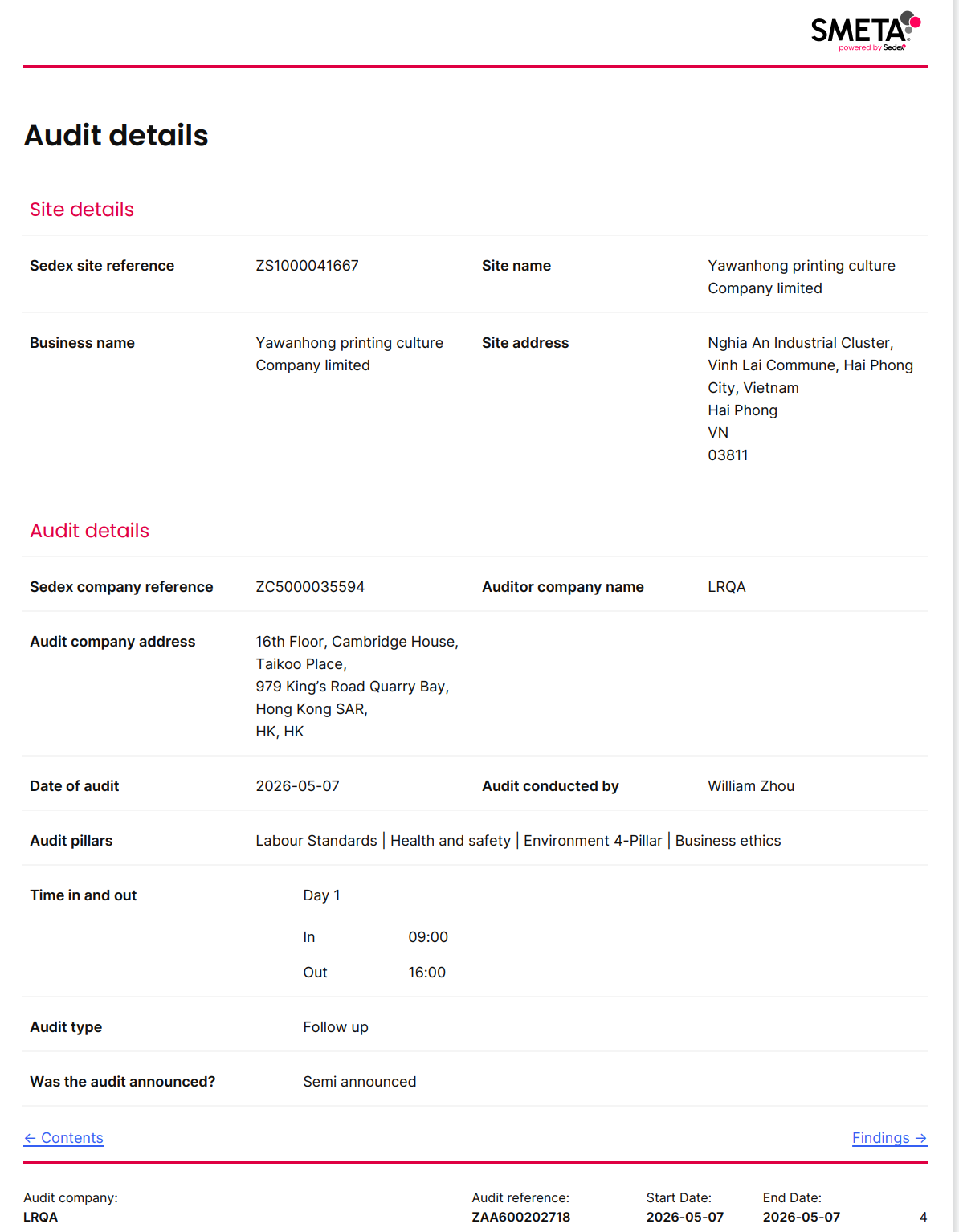
SMETA social compliance audit ZAA600202718, issued by LRQA, covers custom paper printing, board games, card games and paper gift boxes.
FSC chain of custody is raw-material traceability. ISO 9001 is a quality management system. SMETA and BSCI are social audits. A supplier file should hold them as separate evidence types with their own scopes, and buyers should confirm that the site and product scope on each document match the order being placed.
FAQ: Certified Material, Ink and Edge Selection
Which compliance documents should a custom card game order carry, and what does each one cover?
Yawanhong holds four documented compliance credentials. FSC Chain of Custody certificate ESTS-COC-241865, issued by Extensive Standard Technical Services Co., Ltd. under FSC-STD-40-004 V3-1, is valid from 25 November 2024 to 24 November 2029 and covers custom paper printing products, board games, card games, paper gift boxes and notebooks. ISO 9001:2015 certificate 710925, issued by Guardian Independent Certification Ltd, is valid from 24 July 2024 to 23 July 2027 and covers manufacturing and printing of paper board and paper/board packaging plus assembly of custom board games and card games. SMETA audit ZAA600202718 was issued by LRQA on 7 May 2026 against the Sedex SMETA Code, ILO Core Labour Standards and ETI Base Code. amfori BSCI audit 26-0387346, issued by amfori, is valid from 17 April 2026 to 17 April 2028 and references the amfori BSCI Code of Conduct, ILO Core Labour Standards and the UN Universal Declaration of Human Rights. These are different evidence categories — forest custody, quality management and social audit — and should not be presented or accepted as one equivalent bundle. For children’s products sold in the US, the applicable product-safety framework is ASTM F963-23, so the ink and coating specification should be linked to the test coverage required for that market.
What can actually be customized in a custom card game order?
The declared customization scope is material, size, color, logo and packaging, delivered through OEM or ODM production. On the custom card game line (model CG-001) that translates into a custom card size, paper weight of 128–400 gsm, CMYK 4-color or Pantone printing, round or square corners, standard, colored or gold-foil card edges, and matte lamination, glossy lamination, linen, UV coating or varnishing as finish options, using coated paper and art paper as base materials. Packaging is produced in the same order, including box thickness of 1.5–3 mm. The supporting production base is a 55,000 m² facility with 280 employees, a 25-engineer R&D team and a monthly capacity of 80,000 units.
How does the 1,000-unit MOQ affect specification and budget decisions?
Minimum order quantity for these card game projects is 1,000 units, and that threshold shapes how the specification should be used. Because the deck is quoted against a fixed parameter set, the material, ink, finish, edge and packaging choices need to be decided at the RFQ stage rather than adjusted after tooling and sample approval; changes to corner geometry or edge treatment after that point affect tooling and production scheduling. The capacity parameter also works in the buyer’s favour: at 80,000 units per month with a 25–45 day lead time, replenishment of an established specification can be planned inside the same season rather than treated as a new project.
How are samples and pre-shipment acceptance handled?
A physical sample is approved before mass production, and that sample is where the specification is validated: corner radius and edge alignment, color against the approved reference, light transmission through the deck, and stiffness at the specified gsm. After approval the specification is frozen and becomes the reference for the run. In production, quality control is applied as 100% test rather than statistical sampling, and pre-shipment test acceptance checks the finished run for print clarity, cutting neatness and construction sturdiness. The documented five-year OEM card game and board game supply record, covering clients in North America, Europe and Asia, records the outcome as stable quality, clear printing, sturdy construction, neat cutting and eco-friendly properties, with child-safe rounded edge treatment, FSC certified raw materials and full artwork and size customization listed among the project highlights.
What lead time and capacity should buyers plan around?
The declared production parameters are a 25–45 day lead time, a monthly capacity of 80,000 units, a minimum order quantity of 1,000 units, and export markets covering the US, EU, UK and Asia, supported by remote after-sales service. For planning purposes, build the schedule from specification freeze and sample approval rather than from the initial inquiry. To move forward, share the five parameters — paper weight in gsm, ink system, corner and edge style, surface finish and packaging — and request a sample and a quotation against that written specification; the Yawanhong team can be reached at info@yawanhong.vn or on WhatsApp at +1 626 417 3930.
Conclusion
Card game evaluation stops being subjective once the specification is written down. Material determines stiffness and opacity, ink determines color repeatability and compliance coverage, edge and corner treatment determines child safety and durability, surface finish determines how the deck feels and wears, and packaging determines how it survives retail and shipping. Documenting those five parameters, attaching the certificate numbers that back them (FSC ESTS-COC-241865, ISO 9001:2015 710925, SMETA ZAA600202718 and BSCI 26-0387346), and confirming the run against a frozen sample is the difference between an approved sample and a repeatable product.
Yawanhong manufactures custom card games, board games, puzzles, notebooks and color boxes from its Vietnam facility, with OEM and ODM production, 100% test quality control, a 1,000-unit MOQ, 25–45 day lead time and 80,000 units of monthly capacity. Buyers who need the full specification range in one document can download the company brochure, or send the five parameters directly to www.yawanhong.vn to start a sample and quotation request.

Request a sample and quotation: info@yawanhong.vn · WhatsApp +1 626 417 3930 · Nghia An Industrial Cluster, Vinh Lai Ward, Hai Phong City, Vietnam
Download the full manufacturing brochure: Yawanhong VN Group Global Manufacturing (PDF)
Have Questions or Need More Details?
Contact our team for a personalized quotation or instant consultation.
Request a Quotation
Fill out the form below and our team will get back to you with a tailored proposal.
WhatsApp Direct Chat
Prefer to chat in real-time? Message us on WhatsApp for instant assistance & quick answers.
- Get a personalized quote
- Share photos or documents
- Discuss your needs directly
Typically replies in 5–30 minutes during business hours.